
有希望的男人
How Kaifeng is winning foreign hearts with Song culture and open inclusiveness_我的网站

一 |

Fireworks bloomed in golden-red sparks across the night sky, the hems of Hanfu skirts swaying gently in the glow of the lanterns, while the steam from soup dumplings mingled with the bustling sounds of the marketplace. Several foreign tourists held up their phones to capture the atmosphere. This was an ordinary day in Kaifeng, Central China's Henan Province, yet every corner brimmed with the lively atmosphere of Song-era life and an open, welcoming warmth.
This city, once known as Bianliang, the capital of the Northern Song Dynasty a thousand years ago, was already a thriving metropolis that broke the boundaries of traditional wards and markets and opened gates to promote maritime foreign trade.
Today, it continues to carry forward the unique charm of Song culture and an atmosphere of openness and inclusiveness, drawing an increasing number of international visitors — people who are not merely passing through, but many who have chosen to work and live here.
Among them is Xiao Feifei, a performer from Ghana who has been working in Kaifeng for more than a year.
"When I first arrived in Kaifeng, there weren't many foreign visitors in the scenic areas. Now I meet new visitors almost every day — some are European tourists who decided to come on the spur of the moment thanks to convenient visa policies, others are families who specifically bring their children to experience Song culture," he said.
The figures confirm this change: in the first half of 2026, the number of inbound tourists to Kaifeng grew by approximately 130 percent year-on-year, with source markets expanding beyond the traditional Hong Kong, Macao, and Taiwan regions to include multiple countries in Southeast Asia, Europe, and North America.
Why are more and more foreigners willing to come to Kaifeng — and even stay? When Global Times reporters walked through the city, the answers gradually became clear.
'A home to stay'
Xiao Feifei's story with the city begins in 2025. He arrived in Kaifeng and worked as an acrobat and performer in the Wansuishan Martial Arts City, a Disney-style theme park that features many scenes and plays inspired by "Outlaws of the Marsh."
At first he viewed it as just a job — finish each performance to earn a living. But as time passed, he found himself increasingly unable to leave.
"The most unforgettable moment for me was one day after a performance, just as I was about to rest, a security guard wheeled over a boy who was my fan. Unable to speak, he simply stretched out his arms with all his strength, asking for a hug. I bent down and gently held him. In that instant, a tenderness I had never felt before welled up inside me," Xiao Feifei told the Global Times.
"There are also the children who call me 'big bro.' They post videos online looking for me and specially come to play with me. These moments make me feel that I am not merely working — I am truly bringing joy to others," he noted.
It was this sense of purpose, of being accepted and warmly embraced that made Xiao Feifei decide to stay. "I feel the inclusiveness and care of the people here every day. This is how I understand Chinese culture," he said. "Kaifeng has become my second home."
Xiao Feifei is not alone. The scenic area now has more than 200 foreign performers and staff. Zhao Kuan, general manager of Wansuishan Martial Arts City, explained that while the park is rooted in traditional Chinese wuxia culture -- a genre of Chinese fiction or cinema featuring the adventures of martial artists in ancient China, it also incorporates elements from foreign martial traditions, such as Zorro-style figures.
"This allows overseas visitors to find a sense of familiarity while experiencing something uniquely Chinese," Zhao said. "It reflects the open and inclusive spirit of Song culture itself."
Currently, more than 3,000 performances of various sizes themed around wuxia culture — including live-action martial arts dramas and character model shows — are staged every day.
Immersive experience
Martin, a computer technology teacher from Eindhoven in the Netherlands, is visiting China for the first time. This two-week trip has taken him through several cities, and the Millennium City Park, a Song Dynasty-themed park in Kaifeng marks one of his final stops before heading home.
"The moment you step into the park, you are immediately immersed. The colors, the lights, the performances — everything is perfectly coordinated. Even though I don't understand the dialogue, I can clearly feel the historical atmosphere of the ancient Song Dynasty and its everyday street life. It's not simply about performance tricks; it's telling a real story that makes you feel as if you've traveled back in time," Martin told the Global Times.
Millennium City Park is modeled on the renowned painting the Qingming Festival by the Riverside, recreating the street scenes, everyday life, and live performances of the Song Dynasty. Centered on Hanfu styling and makeup, intangible cultural heritage handicrafts, park-wide NPC interactions, and large-scale live shows, the scenic area transforms Song Dynasty rituals, folk customs, aesthetics, and the spirit of family and nation into living scenes that visitors can wear, make, watch, and interact with, an employee from the park told the Global Times.
Foreign tourists need no direct historical knowledge or language skills to appreciate the elegance and vibrant street life of the Song people through costume, hands-on crafts, performances, and interactions, he noted.
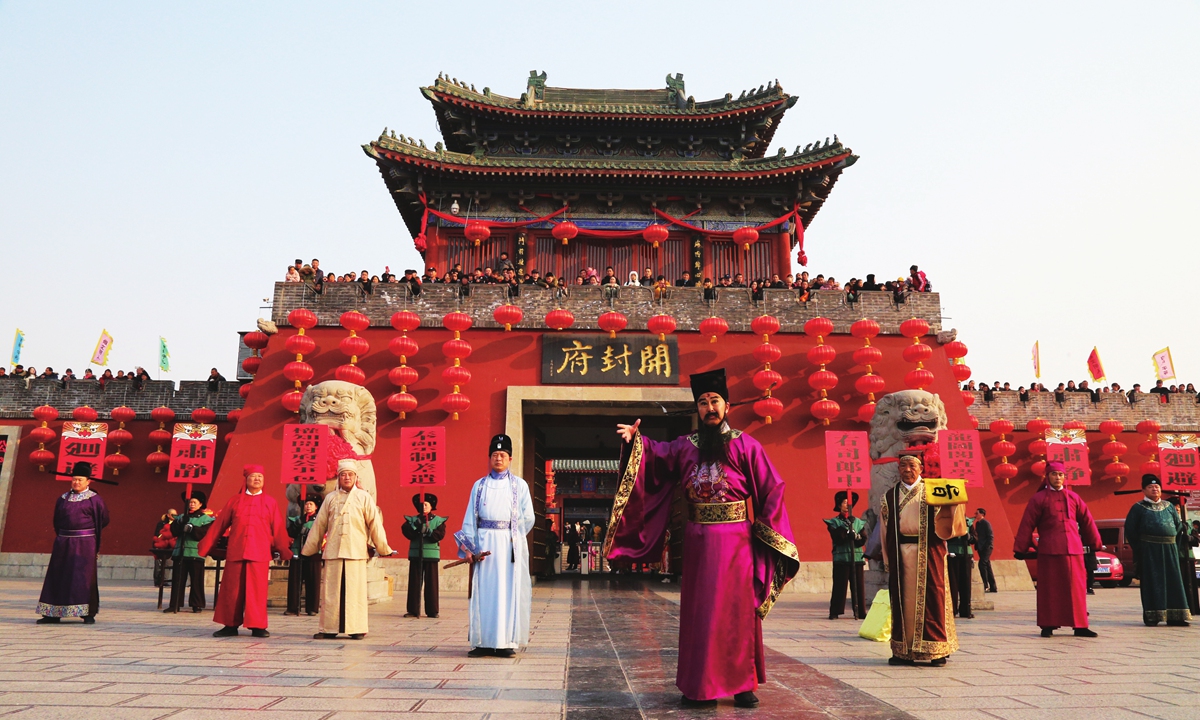
Thai blogger Ake has loved the "Justice Bao" series of films and TV dramas since childhood and has long admired the culture of integrity and chivalry embodied by Bao Zheng, the legendary judge who lived from 999 to 1062 with his expert handling of criminal cases, his fearlessness in giving straightforward advice, and his deep resentment of evil deeds.
When he visited the Ancient Kaifeng County Government, known as the first government office in Ancient China, he actively took part in a simulated court-hearing experience, personally feeling the trial process of a Northern Song prefectural government. He even had the opportunity to take a photo with the actor playing Bao Zheng after performance.
"The culture of integrity and the rule of law represented by Bao Zheng serves as a shared emotional resonance for tourists both at home and abroad. The spiritual core of fairness, justice, and caring for the people for the public good resonates with the common aspirations of people from different regions," Duan Bo, the general manager, told the Global Times.
The scenic area centers on recreating feel and style of the Northern Song government, including the main court hall and the council hall. Combined with a series of live-action performances centered around Bao Gong's case trials, it allows visitors to gain an intuitive understanding of how the prefectural government operated at that time, he added.
Unique attraction
Kaifeng, known as China's "Ancient Capital of Eight Dynasties," became the world's first metropolis with a population of one million during the Northern Song Dynasty. It features a globally unique "city-upon-city" wonder of six stacked cities, and its central axis has remained unchanged for a thousand years, Liu Dong, deputy director of Kaifeng Municipal Bureau of Culture, Radio, Television and Tourism, told the Global Times.
In addition to its rich cultural atmosphere, Kaifeng is home to many historical relics: the Iron Pagoda, the city's landmark with nearly thousand-year-old history, and the Fan Pagoda, the city's the oldest surviving above-ground structure. The Great Xiangguo Temple was a royal monastery of the Northern Song, while the Zhou Bridge relics recreate the prosperous scenes of the Bianhe River from a thousand years ago, according to Liu.
How has Kaifeng utilized its rich cultural resources to transform itself into a renowned tourist city?
"We have consistently adhered to the principle of balancing protection and "development" in its cultural tourism policy," Liu said.
On the one hand, important historical sites have been protected through physical restoration and digital preventive conservation. On the other hand, each scenic area is required to have a clear positioning and distinctive features — The Millennium City Park deeply cultivates folk customs and street life, creating a sense of time travel; the Ancient Kaifeng County Government highlights the culture of the rule of law and integrity; while Wansuishan Martial Arts City revitalizes wuxia narratives, emphasizing interactive immersion, Liu noted.
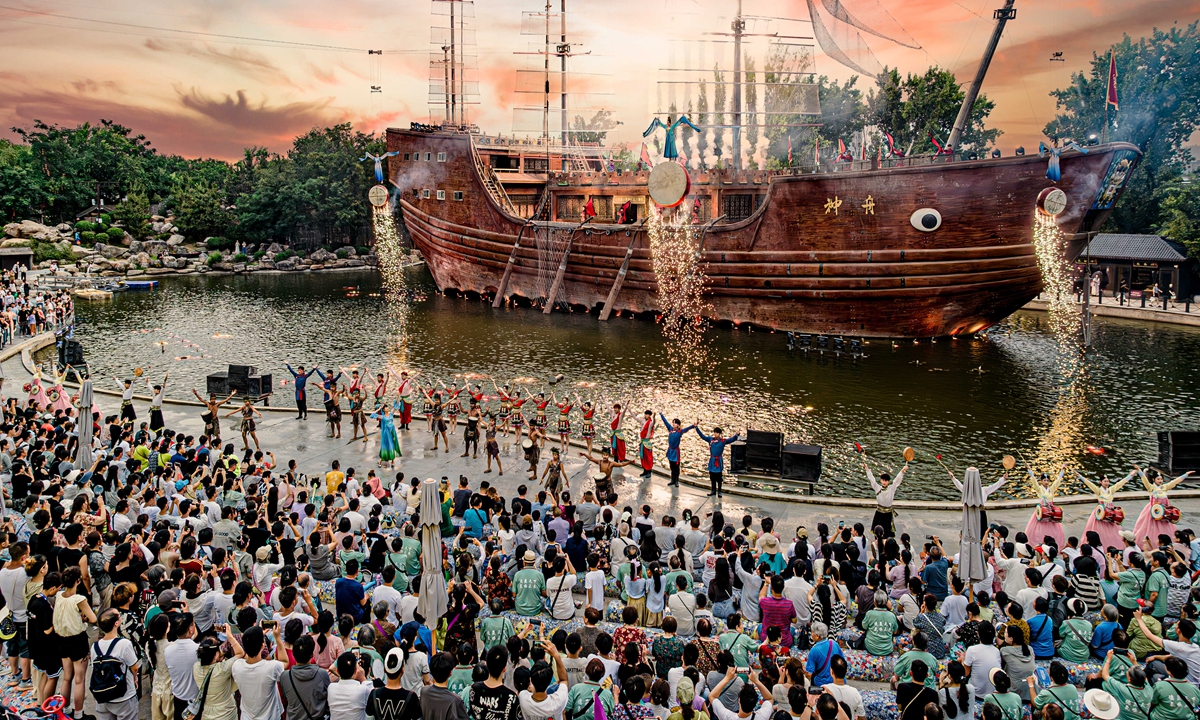
Boosted by China's visa-free policy, the "one ticket for three days" offer adopted by many scenic areas in the city has become even more appealing. It allows visitors to enter the same scenic area multiple times within three days with a single ticket.
"We don't have to rush. We can take our time watching the performances and wandering around. One day is nowhere near enough — this policy is so thoughtful," a visitor surnamed Yang, who is from Denmark and traveling with her husband, told the Global Times in the Millennium City Park.
Meanwhile, Kaifeng offers a full-service experience for foreign visitors: bank branches provide bilingual assistance for cash withdrawals and currency exchange; the immigration hall has a dedicated green channel for visa-free transit travelers, enabling quick handling of lost documents and other emergencies; and multilingual signage has been upgraded across all A-level scenic spots, tourist hubs, museums, and pedestrian streets, the bureau said.
All of these measures resonate with the spirit of the Central Urban Work Conference in 2025, which highlights efforts to build culturally-vibrant cities characterized by high ethical and moral standards. By effectively protecting and revitalizing Song culture and delivering high-quality services, Kaifeng has made foreign visitors not only willing to come but also willing to stay longer and return — precisely practicing the requirements of building a "livable" and "culturally vibrant" city.
As a new day begins, Large-scale immersive performances and processions unfold, NPC characters weave through the ancient streets interacting with visitors, and the entire city is illuminated by light, sound, and the everyday vitality of the marketplace.
A thousand years ago, Bianliang was an open and inclusive world-class metropolis. Today's Kaifeng, with its Song-dynasty elegance and sincere hospitality, once again opens its doors to the world — and quietly captures the hearts of many who have come from afar.
。 EA Rajendran, a versatile performer who made his mark across theatre, films and television, has passed away at the age of 71. He had been undergoing treatment for a prolonged illness and breathed his last at his residence in Pattathanam, Kollam.From stage roots to screen presenceRajendran’s journey into the arts began on the stage, where he first discovered his passion for performance. Born to Ayyappan and Sumathi in the Engoor Tharavadu at Thrithallur in Thrissur district, he showed an early inclination towards acting during his school days at Thrithallur U P School. His participation in literary society plays laid the foundation for what would become a lifelong commitment to the performing arts.After completing his college education, Rajendran joined the National School of Drama in Delhi, graduating with first rank, a testament to his dedication and craft. He later honed his skills further by pursuing a television course at the Film and Television Institute of India, equipping himself with a deeper understanding of the medium.A life intertwined with theatre and familyIt was during this period that Rajendran met Sandhya, daughter of veteran actor O Madhavan, and sister of Mukesh. Their shared passion for theatre soon turned into a partnership in life, with the two getting married while Sandhya was still a student at the Thrissur School of Drama.Following their marriage, Rajendran settled in Kollam and became closely associated with Kalidasa Kalakendram, the theatre troupe led by his father-in-law. Here, he found a creative home, contributing significantly to its productions and growth. One of his notable achievements was adapting a Russian novel into a stage play with the support of playwright Jose Chirammal. The production went on to win the Kerala State Government Award for Best Play in 1987.For several years, Rajendran and Sandhya were central figures in the troupe’s performances, shaping its identity and repertoire. During this period, Sandhya was honoured with the State Award for Best Theatre Actress, reflecting the couple’s strong presence in Kerala’s theatre circuit. Cinema, television and beyondAlthough Rajendran stepped into cinema early with Greeshmam, directed by V R Gopinath, consistent opportunities in films did not immediately follow. It was after a considerable gap that he returned to the screen with Kaliyattam, directed by Jayaraj. The film marked a turning point, leading to a steady stream of roles in Malayalam cinema.Over the years, he appeared in around sixty films, taking on a wide range of characters that spanned antagonistic roles to nuanced supporting parts. His performances in films like Pranayavarnangal, Daya and Pattabhishekam showcased his ability to adapt to different genres and storytelling styles.In addition to films, Rajendran was a familiar presence on Malayalam television, appearing in several serials that brought him into households across the state. His contributions were not limited to the arts alone. He also served as Chairman of the State Horticulture Corporation, balancing public service with his creative pursuits.Rajendran’s passing marks the end of a career that quietly but consistently enriched Malayalam performing arts. From his early days on stage to his work in cinema and television, he remained committed to his craft, leaving behind a body of work that reflects both versatility and dedication.Also Read: Tovino Thomas’ Pallichattambi Teaser Drops As Makers Shift Release Date。
Current article:http://bese73o.runtunpaixufenjuduishuang.pics/6soha5/re9.html
Published on:00:23:08


